
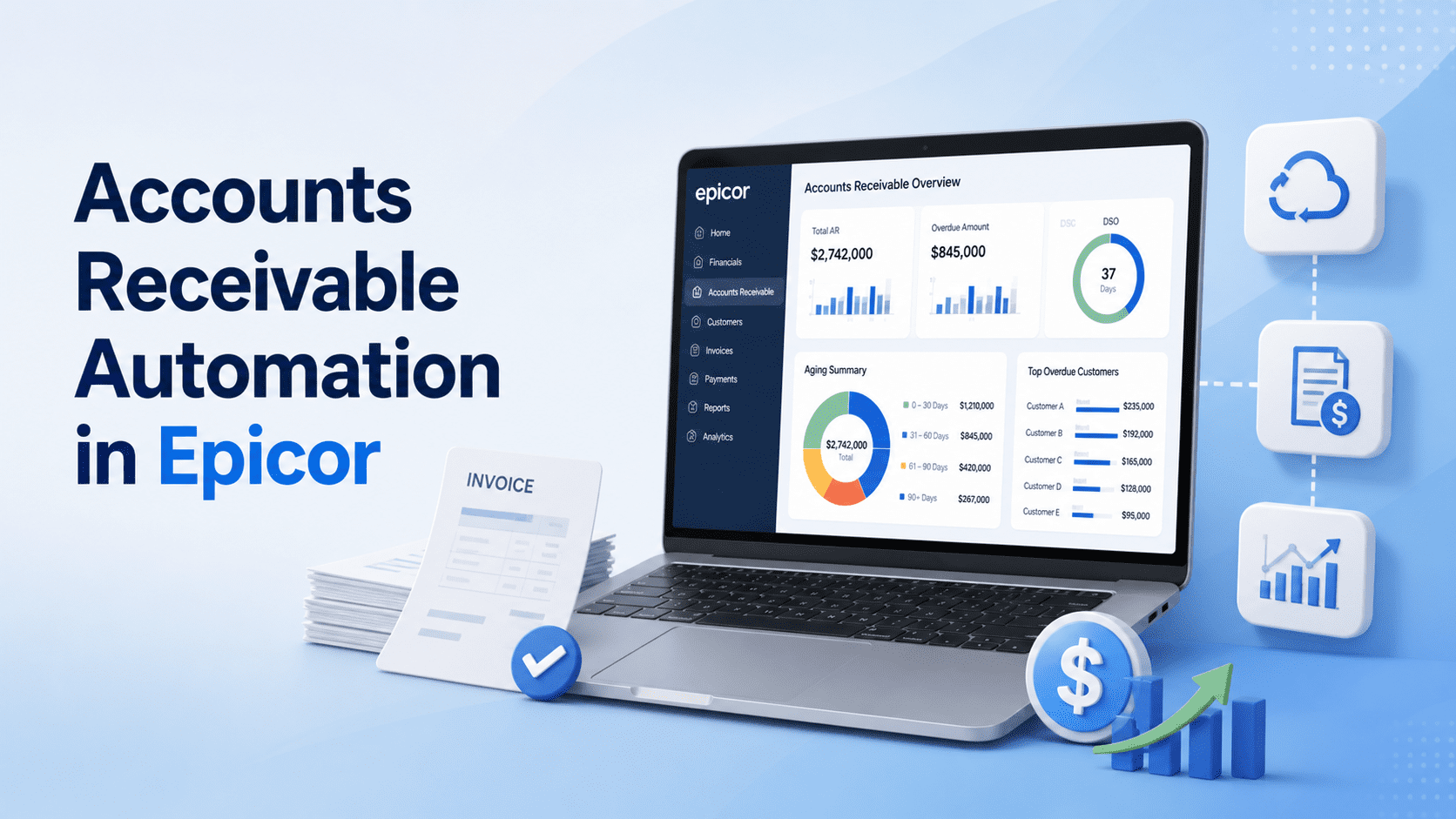
Epicor ERP provides a solid foundation for managing financial operations, including accounts receivable. It handles invoicing, customer records, and payment tracking effectively as a system of record.
However, when it comes to executing day-to-day receivables workflows—collections, follow-ups, dispute resolution, and cash application—most finance teams still rely heavily on manual processes outside the ERP.
As businesses scale, this gap becomes more visible. Epicor manages data well, but it is not built for real-time, automated, or intelligent AR execution. This is where modern AR automation platforms like FinFloh come in.
Table of Contents
Understanding Accounts Receivable in Epicor
What Epicor Does Well
Epicor provides core AR capabilities such as invoice generation, receivables tracking, customer management, and payment posting. It ensures data consistency and serves as the central system for financial transactions.
Where Epicor Falls Short for AR Automation
Epicor is not designed for proactive receivables management. Critical workflows such as collections prioritization, automated follow-ups, dispute tracking, and intelligent payment matching are either manual or require external handling.
Finance teams often end up managing receivables through spreadsheets, emails, and disconnected tools, leading to inefficiencies and delays.
Why AR Processes Break Down in Epicor
Manual Collections and Follow-Ups
Collections in Epicor typically rely on static reports and manual tracking, requiring teams to decide who to follow up with and when, which leads to inconsistent execution.
Limited Real-Time Visibility
Epicor does not provide a unified, real-time view of receivables, customer risk, and collections performance, making it difficult to take proactive action.
Inefficient Cash Application
Matching payments to invoices often requires manual effort, especially when remittance data is incomplete, resulting in unapplied cash and reconciliation delays.
Fragmented Dispute Management
Disputes are not managed through structured workflows, causing delays in resolution and increasing invoice aging.

What Modern AR Automation Looks Like
Today’s receivables processes require continuous monitoring, intelligent prioritization, and automated execution rather than periodic, manual intervention.
Modern AR automation platforms provide:
Proactive Collections Execution
Systems continuously track receivables and trigger follow-ups automatically based on customer behavior and risk signals.
Intelligent Payment Matching
Advanced matching capabilities handle incomplete or inconsistent data, reducing manual reconciliation.
Structured Dispute Workflows
Disputes are captured, tracked, and resolved within defined workflows, improving visibility and turnaround time.
Real-Time AR Visibility
Finance teams get instant access to receivables, aging, and performance metrics, enabling faster decisions.
How FinFloh Extends Epicor for AR Automation
Epicor remains the system of record, while FinFloh acts as the execution layer that brings automation and intelligence to receivables.
Seamless Integration With Epicor
FinFloh integrates directly with Epicor, leveraging existing financial data without disrupting ERP workflows.
AI-Driven Collections
Collections are automated and prioritized using AI, ensuring timely follow-ups and improved recovery rates.
Automated Cash Application
Payments are matched to invoices with high accuracy, reducing unapplied cash and manual effort.
Dispute and Deduction Management
Structured workflows ensure faster identification and resolution of disputes.
Unified, Real-Time Visibility
Finance teams gain a complete, real-time view of receivables, collections, and cash flow performance.
To implement FinFloh’s AI Engine for A/R integrated with Epicor, you can check out FinFloh A/R product page. You can also Book a Demo to see how the product works or you can Book a Free Trial for a first-hand experience of the product.
Why Finance Teams Move Beyond Epicor for AR
As transaction volumes increase, manual processes within Epicor become harder to scale. Finance teams spend more time managing tasks than improving outcomes.
By adding an automation layer, businesses can transform receivables into a proactive function that drives cash flow rather than reacting to delays.
Best Approach to Modernizing AR in Epicor
Keep Epicor as the System of Record
Epicor continues to manage financial transactions and ensure data integrity.
Add an Automation Layer for Execution
Introduce a platform like FinFloh to handle collections, cash application, and dispute workflows dynamically.
Focus on High-Impact Areas
Start with collections and cash application, where automation delivers immediate ROI.
Continuously Improve With Data
Use real-time insights to refine strategies and improve performance over time.
Conclusion
Epicor is a strong ERP for managing financial data, but it was not built for modern accounts receivable automation.
As finance teams face increasing complexity, relying solely on ERP-driven processes leads to inefficiencies and missed opportunities. By extending Epicor with an automation layer like FinFloh, businesses can unlock faster collections, better visibility, and scalable AR operations.
The future of accounts receivable is not inside the ERP alone—it is built on top of it.